 How do I calculate the FIRE Number? Let me start with a story. A few months ago, I stood motionless inside my Sydney apartment. The place smelled faintly of cardboard and dust – the kind that clings to old bookshelves and forgotten corners. Around me, piles of neatly packed boxes were stacked like uneven skyscrapers against the wall. Each box was labelled in thick black texta, though half the time I had already forgotten what was inside.
A year earlier, I had quit my job, surprising everyone – including myself. And now here I was: jobless, staring at a wall of boxes, clutter threatening to topple over, and wondering if I had enough money to attempt what I was about to embark on.
My chest felt tight: equal parts fear, equal parts excitement. It was like standing on the edge of a cliff, knowing the view was incredible but also aware of how far the drop could be.
I had confidence though, because of two widely used rules for money management in FIRE. They are actually closely related. They are the 4% Rule and the 25x Rule.
The 4% Rule and the “Trinity Study”
The 4% Rule comes from the Trinity Study, a 1998 paper by three professors at Trinity University that looked at historical stock and bond returns to figure out a “safe withdrawal rate” (SWR): the percentage of your investment portfolio you can withdraw annually without running out of money over a typical retirement (30 years).
The rule states that if you withdraw 4% of your portfolio per year, adjusting for inflation, you have a very high chance of your money lasting for 30 years or more.
Example: (enclose in a box)
If you had $1,000,000 total invested, you could withdraw $40,000 in the first year. The next year, you’d increase that amount to keep up with inflation – say, $40,800 if inflation was 2% – regardless of what the market did.
25✕ rule
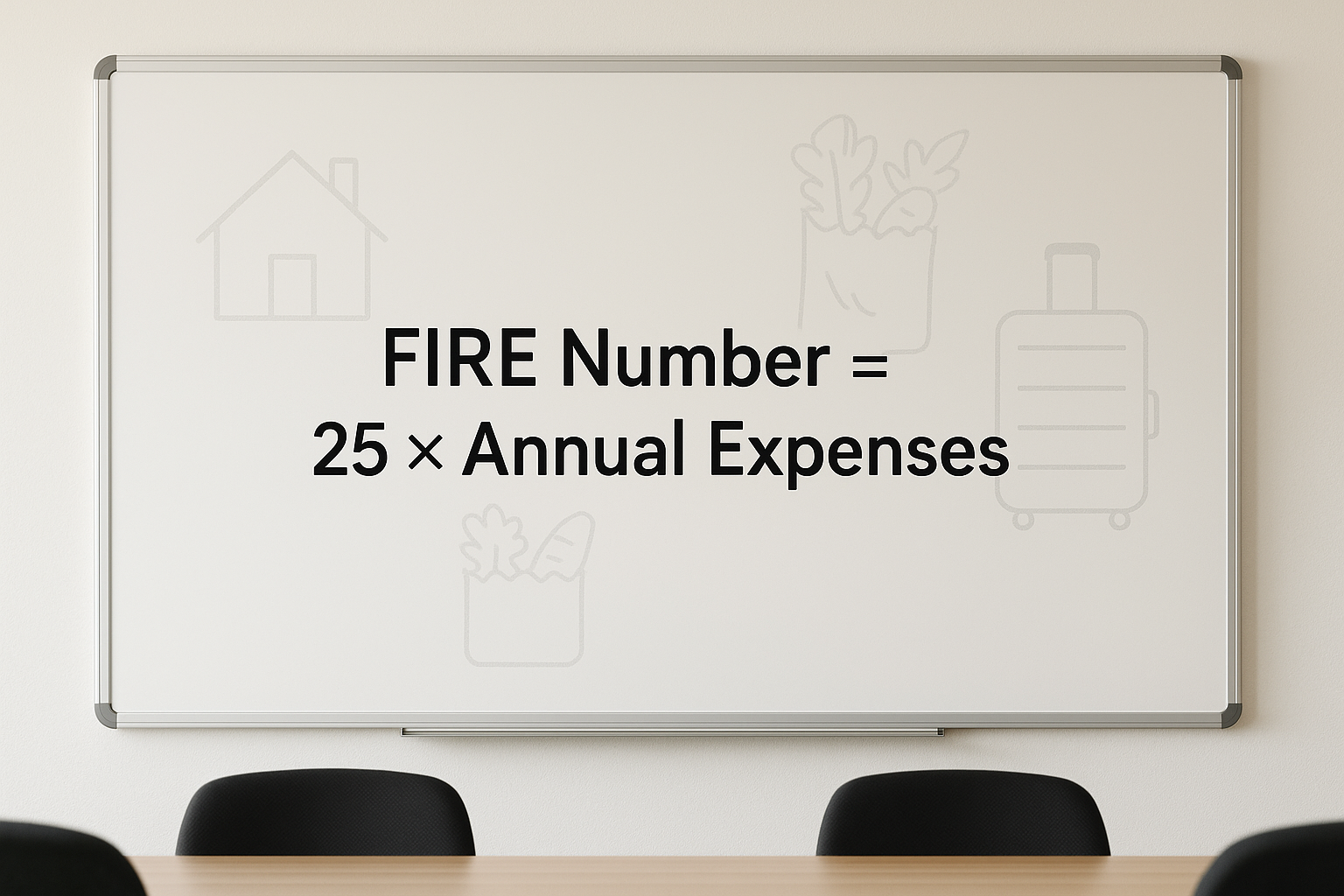
Similarly, the 25✕ Rule is just the inverse of the 4% Rule. The rule states that if your total amount invested is 25 times your annual expenses, you can afford to retire. Hence the 25✕. 1 divided by 4% = 25. Hence, to calculate the FIRE Number, you just need to multiply your annual expenses by 25.
This is called your FIRE Number.
You can retire earlier if
- Total investments is increased
- Annual expenses is reduced
In all likelihood, only one of these is able to be manipulated by you easily.
My Personal Example – My FIRE Number

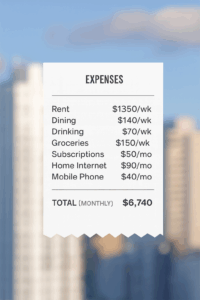
I worked as a software developer earning $220,000 as an annual salary, which is roughly $2,500–$2,600 per week take-home. Accordingly, my lifestyle matched this: I had a penthouse on the top floor of a Sydney city apartment block which I was renting for $1350 a week.
My partner and I would eat out two or three times a week, usually in the city centre. If your city is anything like Sydney, we truly were experiencing a “cost of living crisis” and everything now is noticeably more expensive. For two people, eating out would be anywhere between $50 and $90. We would go out drinking once or twice, which would be around $70 for the two of us. Groceries would be around $150 a week. My subscriptions would be $50 a month including Netflix, Disney+ and Prime. Home internet would be $90 a month. Mobile phone subscriptions would be $40 a month.
If you say my total liquid investments were worth $2 million, could I afford to retire?
To answer this question, I need to calculate the FIRE number, again.
Adding up my expenses, it would be (very roughly):

Actions:
Sum your expenses and calculate the FIRE number and have a think about how to get yourself closer to retiring.