

These 10 FIRE Saving Tips will help you save more, maximise your investments, and a retiring earlier than you ever thought possible.
Saving is difficult.
When people start saving for FIRE, they commonly adopt two different strategies.
One strategy they may go is they start slashing all expenses. They live off baked beans, they slash all entertainment and stay home. Their life becomes a misery. This is not sustainable.
The other strategy is to give their expenses a small haircut. A small snip here, another snip there, all around the edges. Nothing really changes and their FIRE dream gets further and further away. Sooner or later, they give up their FIRE dream.
People need to switch their mindset for their saving strategy and it will make their life easier.
1. Keep Track of Your Finances
One thing that really made a difference for my finances was to regularly review where my money was going. I use Excel but you can use the personal finance apps YNAB, Simplifi or similar. It is interesting when you can see all your money and expenses in one place. There is something weirdly enlightening when you see your money coming in against the money coming out, all in one place. It’s no longer just an abstract number on a fortnightly payslip or a few numbers on one of several credit card statements.
Things become a lot clearer when you have everything on a single page.
Quick Win: Cancel 2–3 unused subscriptions today. That alone could boost your savings rate by 1–2%.
2. Pay yourself first
I have an old uni friend who is on a reasonable salary. His wife is a blue collar worker and earns an average wage. They always seem to be on Struggle Street. They seem to live on paycheck to paycheck and sometimes they need to forego social occasions because they just don’t have the money, but this is only ever spoken of in hushed tones to save embarrassment. They will say something like “We can’t go to James’s drinks because we have Jane’s birthday to go to.”. This is their way of budgeting so that they don’t run out of money.
He recently got a pay rise and they realised they have a lot more money to spend. They bought a new Thermomix, a new PS5 and a brand new, top of the line Dyson vacuum. Unfortunately, they again have no money left over, every week. One could even say that the new money seems to have been hoovered up and has disappeared. They are still on Struggle Street.
So, what did they do wrong?
They should have paid themselves first. The concept of “Pay Yourself First” actually comes from The Richest Man in Babylon by George S Claxon. It was adopted by Richard Kiyosaki in Rich Dad, Poor Dad.
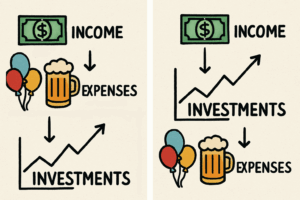
What my friend was doing wrong was paying their bills first, then spending their money, and what was left over was then meant to be put into savings and investments. But sadly, nothing was left over! What they should have been doing is to “pay themselves first” – put a fixed amount into savings and investments, then expenses and then, finally they could spend how they wanted.
The difference is savings and investments would become the priority. Non-negotiable. Previously, their spending was the priority, because it made them feel good.
3. Easy Wins: Rent, Transport, and Dining out
I myself found the biggest savings came from cutting the biggest expenses.
-
- Housing: When COVID struck, I moved into the apartment I owned. This saved me huge amounts of money. Not everyone can do this, but moving to somewhere cheaper (eg. unpopular suburbs rather than the coolest ones) can save you heaps.
-
- Transport: Moving to Sydney, I lived in the suburb of Newtown and I had two train stations close to me, as well as several bus routes. Selling my car and using public transport cut registration, insurance, fuel, and maintenance costs in one fell swoop.
-
- Food: My partner and I love eating out and whilst it is one of the joys of life, it is a serious money sink. We then started cooking most nights. This slashed our weekly food bill and actually improved our health. We also cooked more than we ate, saving us cooking time in the coming days,
If you concentrate on these big ticket items, you can cut 30–40% of expenses without even looking at the nice, little expenses that really give you a lot of pleasure.
Pro Tip: Start with whatever uses the biggest chunk of money. No one gets rich by making little cuts on the sides.
4. Maximise Your Pay
Cutting expenses only gets you so far. One way to get to FIRE faster is to increase your income.
During my IT career, asking for raises and switching companies added more to my investments than any budget tweak ever could. I told this to a friend – if you don’t ask, you won’t receive. Ever. If you think you deserve a raise, don’t just be disgruntled and grumble about it. Ask for one.
But once you start earning more, the trick is to avoid “lifestyle creep.” Don’t be like my friend. Every time your income rises, don’t let your lifestyle swallow your gains.
Quick Win: If you’ve been in your role for a reasonable time (say a year), prepare a raise request this month. Even a small 5% bump can help.

5. Optimise Taxes and Benefits
Pensions and tax- effective investments are boring: there is no other way to say it. That is why they are one of the most overlooked ways to increase your wealth. In Australia, maxing out superannuation contributions is a popular recommendation from financial planners. In the US, it’s 401(k)s, IRAs, and HSAs.
Employer matches are literally free money. And investing in tax-efficient accounts means more of your money is working for you, not for the tax man.
Pro Tip: If your employer will match your contributions, take advantage of it – it’s a no-brainer. Free money.
6. Live mindfully and joyfully
Marie Kondo popularised the phrase “Does it spark joy?”
When you spend money, let your money spark joy and for things that don’t spark joy, cut!
Are there subscriptions that have run out of things to watch? Cut!
Do your 5 coffees a week spark joy? Yes? Keep!
Does your Amazon Prime bring joy? Yes? Keep!
Do you really need that bottle of wine to drink at home? No? Not really? Cut!
The trick is spending mindfully.
Quick Win: Have a think and find your top 3 spending categories that actually spark joy. Cut back elsewhere, but safeguard these.
7. Put your savings on autopilot
If saving requires manual action, it won’t last. I like to call it Barrier to Entry.
My gym was 10 minutes walk away from my Newtown apartment. Guess what happened next? I first started going 3 days a week, it got reduced to 2 and sooner or later, it was easier to say I can’t be bothered.
That will happen with the savings if it requires you to remember each week or fortnight when the pay comes in. That’s why I set up automatic transfers – part of my paycheck goes straight to investments before it ever hits my transaction account.
Some savings accounts also allow you to create separate accounts or buckets, as I like to call them. Separate buckets for short-term goals (like travel) and long-term FIRE goals keep things simple. Out of sight, out of mind.
Pro Tip: Treat savings like a necessary bill that needs to be paid. Once it’s automated, you’ll never need to think about it. FIRE and Forget!
8. Lifestyle Design and Geo-Arbitrage
Sydney, like other capital cities in the world, is currently experiencing a cost of living crisis. It is really expensive to rent an apartment, eat out and live your life.
I moved to Thailand and not only did my FIRE number drastically reduce, it also provided me with a circuit breaker to get my life in order. My health has improved and I have found the time to strip my expenses of anything that didn’t spark joy.
Earning in a strong currency while living in a low-cost area: even if you don’t move abroad, moving to a less expensive city or suburb can have a major impact. A change in scenery may not necessarily be just a breath of fresh air.
Quick Win: Research cost-of-living calculators for 2–3 cities. You might find you can halve expenses without halving lifestyle.
9. Track Progress and Stay Motivated
When I first hit a 30% savings rate, it felt impossible to push further. But once I tracked it monthly and celebrated hitting 40%, then 50%, it became a game.
 Use FIRE calculators to project your timeline. Watching your “years to financial independence” number shrink is incredibly motivating.
Pro Tip: Print your savings rate chart and stick it on your fridge. Daily visual reminders keep motivation high.
10. Common Pitfalls to Avoid
-
- Cutting too many lifestyle expenses: If you slash everything, your life will be miserable.
-
- Not involving your partner: Going it alone can cause strain on relationships.
⚡ Quick Win: Regularly review your savings journey with your partner or friend. This may help motivation by keeping you accountable.
Conclusion
Start with the big wins first, and using the tips above, you should be able to save a substantial amount of money.
